
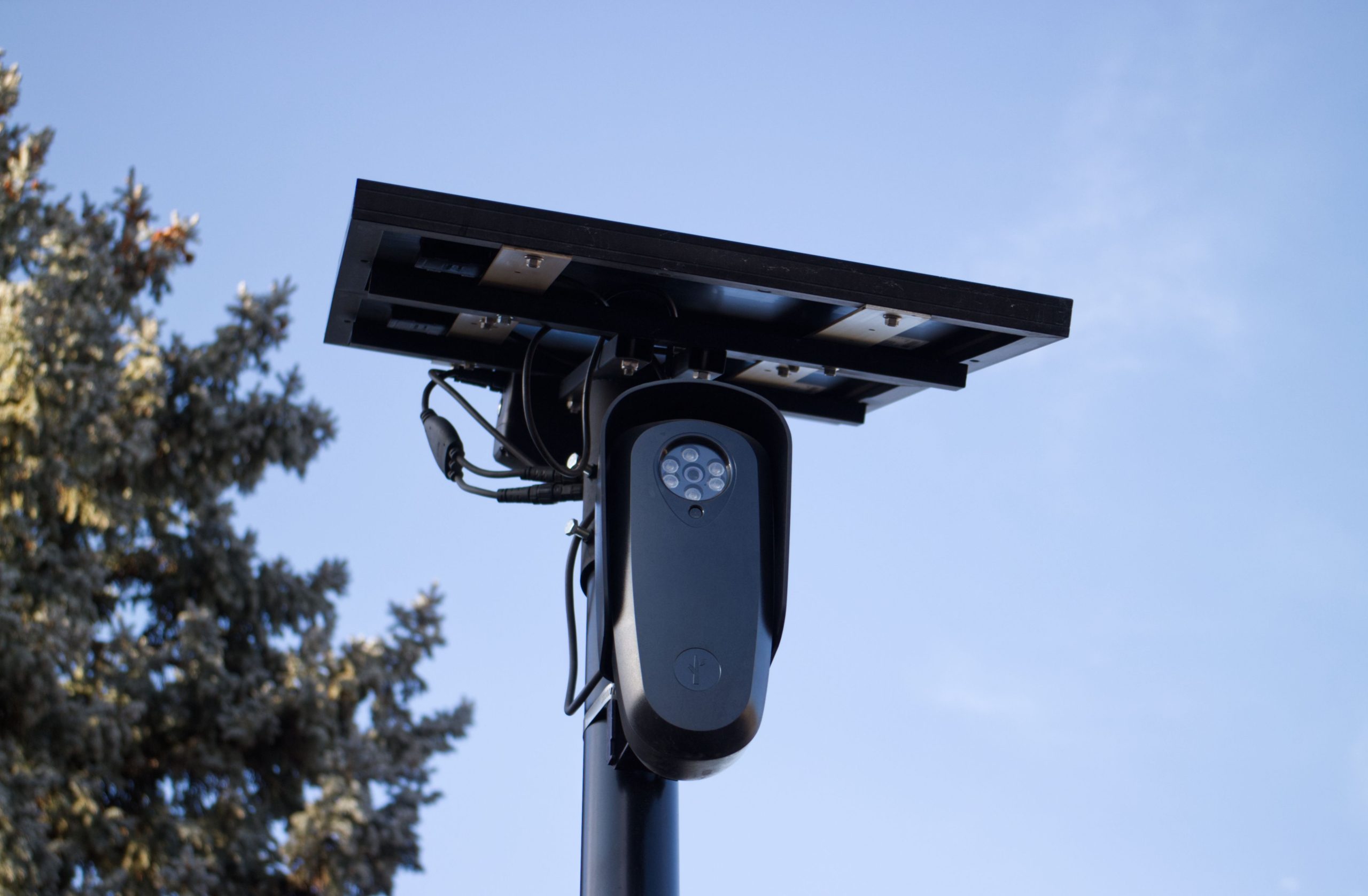
Most site cameras don’t fail dramatically. Nobody smashes them and nothing catches fire. They just go quiet. Somewhere around Thursday night the power runs low, the camera drops offline, and you only find out on Monday when you open the app and see a frozen image from four days ago.
On a construction site, that’s nearly always a power problem. It’s the main reason the solar CCTV vs battery-powered CCTV question matters more than people expect. Both can do a good job. Both can let you down if they’re put on the wrong site.
This post covers how each one actually gets its power, how long it runs, what Melbourne’s winter does to it, and which sites suit which. We’re Site CCTV, and we put cameras on building sites around Melbourne every week. A lot of what follows comes from watching what works on real blocks and what doesn’t.
First, a mix-up worth clearing up
Here’s something that surprises a lot of builders. Solar CCTV units run on batteries too.
The solar panel doesn’t power the camera directly. It charges a battery bank, and the battery runs the camera, the recorder and the 4G connection. During the day, the panel tops the battery up. At night, the camera lives off whatever’s stored.
So the real difference is how the battery gets refilled.
- Solar units recharge themselves from the sun, as long as there’s enough of it.
- Battery-powered units have no panel. When the battery runs down, someone swaps it for a charged one or takes it away to recharge.
Once you see it that way, most of the other differences make sense. A solar unit depends on sunlight. A battery unit depends on people turning up on schedule.
How a solar unit keeps itself going
A typical solar site camera sits on a trailer or a tall mast. It has a panel on top, a battery box down low, and cameras pointed at the parts of the site that matter.
When it’s set up well, it runs for weeks or months without anyone touching it. That’s the big appeal. You put it in at slab stage and it can still be humming along at lock-up, with nobody hauling batteries in and out.
The words doing the heavy lifting there are “set up well”. The panel needs to be big enough and pointed the right way, roughly north here in Melbourne. The battery needs to hold enough charge to get through the night, plus a buffer for the days when the sun barely shows up. Get either one wrong and the unit will work fine in summer and struggle by May.
Solar units also tend to be bigger. A trailer needs somewhere to park and a clear patch of sky above it. On a roomy block in a new estate, that’s easy. On a tight inner-city site, it can be a puzzle.
What battery-powered actually means on site
Battery-only cameras are usually more compact. Some mount on a fence panel, a pole or the side of a site shed. There’s no panel to aim and no trailer to park, so they can go places a solar unit can’t.
The catch is that a battery only holds so much. How long it lasts depends on a few things:
- How big the battery is
- How many cameras it’s running
- Whether it records all the time or only when something moves
- How often it sends footage or alerts over 4G
- How cold it is
A busy site with lots of movement will chew through power faster than a quiet one. A camera that sends you a clip every time a cat crosses the slab will drain sooner than one with sensible alert settings.
So someone has to keep track of the swap schedule. If the provider handles it, that’s usually built into the service. If it falls to your team, it becomes one more job for a supervisor who’s already got enough on.
A battery unit with a missed swap is like a fire extinguisher nobody’s checked. It looks fine right up until you need it.
June in Melbourne is the real test
Anyone can make a solar camera work in January. The test comes in winter.
Melbourne’s winter days are short and often grey. You can get a run of overcast days where the sun barely gets through, and the panel only collects a fraction of what it would in summer. Meanwhile the nights are long, so the camera has to run on stored power for a lot more hours.
That’s a squeeze from both ends: less charge going in and more being used. A solar unit sized only for summer will often get through the first cloudy day, struggle on the second and go flat on the third.
A good setup plans for this. That means a bigger battery bank, a panel with some headroom, and power settings tuned so the camera isn’t wasting energy. Some providers use units with a backup option, such as a small generator that kicks in when the battery runs low. Before anything goes in, it pays to ask how a unit is expected to cope with a bad week in July, not an average one.
Battery-only units don’t care about cloud. They do care about cold, though. Batteries tend to lose some of their capacity on freezing nights, so a battery that lasts a certain number of days in autumn may come up a bit short in mid-winter. That usually means swapping more often, and someone has to allow for it.
Shadows, scaffolding and the inner-city problem
Solar panels need direct sun. That sounds obvious, but building sites are very good at blocking it.
On an inner-city job in Collingwood, Richmond or Fitzroy, you might be wedged between a three-storey terrace on one side and an apartment block on the other. The winter sun sits low in the northern sky, and a lot of these sites barely see it from May to August. A solar panel in that spot might get a couple of hours of weak light a day.
Then the building itself starts getting in the way. The frame goes up. Scaffolding wraps the whole thing. Shade cloth goes on. A spot that got good sun in March could be in shadow by June, purely because of what you’ve built next to it.
This is where battery-powered units often earn their keep. They don’t need sky, so they can go in a shady laneway, under an awning or tucked against a hoarding. On tight sites with poor sun, they’re often the more reliable choice, as long as the swaps are sorted.
That’s not to say solar never works in the inner suburbs. Sometimes there’s a clear spot on a corner, or the panel can be mounted high enough to catch the light. It just needs a proper look first, ideally with winter in mind.
Out in the growth corridors
Head out to the new estates around Tarneit, Rockbank, Wollert, Donnybrook or Clyde North and the picture changes.
Blocks are wide open, neighbours are few, and there’s plenty of sky. There’s often no power connected either, sometimes for months. Nobody’s around at night, and the streets can be properly dark.
Solar tends to shine here, literally. There’s nothing to block the panel, and a well-sized unit can run for the whole risky stretch of the build without anyone visiting. That matters when the site is a 40-minute drive from your office and you’d rather not make the trip just to swap a battery.
Battery units can still work on these sites, but the travel adds up. If someone has to drive out every few days, that’s fuel, time and one more thing to forget. Over a long build, that can tip the balance toward solar.
Mobile reception is worth checking in either case. Some new estates have patchy coverage, and a camera with a full battery is only so useful if it can’t send you an alert.
Sites change shape, and cameras have to keep up
A slab is open ground. A frame is a maze. A locked-up house has walls everywhere. The laydown area moves, the skip bin moves, and the gate sometimes moves too.
Every time the site changes, camera angles can stop working. You might need to shift a unit to keep the gate in view or to cover a new storage spot.
Battery-powered units are usually easier to move around. Unclip, carry, remount, done. They’re handy on renovations and tight sites where the best spot keeps changing.
Solar units take a bit more thought. When you move one, you’re not only picking a good camera angle. You’re also looking for a sunny spot. Sometimes those two things line up and sometimes they don’t. A trailer unit is still fairly simple to tow to a new position, but it’s worth checking the new spot won’t sit in shade once the next stage goes up.
The upkeep nobody budgets for
Neither system is truly set and forget, though solar comes closer when it’s sized right.
With solar, the panel needs to stay reasonably clean. Building sites are dusty, and a panel coated in grime from a week of cutting and earthworks won’t charge as well. The batteries also wear down slowly over time, and they rarely give much warning. A provider should be keeping an eye on battery health remotely and swapping out tired ones before they cause trouble.
With battery units, the main job is the swap itself. Charged batteries need to be on hand, the flat ones need recharging, and someone has to turn up on time. Miss a swap over a long weekend and that’s exactly when you’ll wish you hadn’t.
Both types can get knocked by a bobcat, blown around in a strong northerly or targeted by someone with a crowbar. That’s just site life.
A made-up example, to show how it plays out
This is a hypothetical scenario, not a real customer story.
Picture a builder called Ben who’s running two jobs at once. One is a single double-storey on a new estate in Mickleham. The other is a rear extension on a narrow Victorian in North Melbourne, with a two-storey neighbour on the north side.
For Mickleham, a solar trailer is a fairly easy call. The block is wide open with no power, it’s a long drive from his other job, and the sky’s clear in every direction. With the unit sized for winter, he can mostly forget about it and just check the app.
North Melbourne is a different story. The backyard gets almost no winter sun, and the only access is down a side path. A solar trailer would struggle to fit, let alone charge. A compact battery unit mounted near the rear gate covers the tools and materials without needing the sun. The swaps are booked in, and since the site is close to town, they’re not much of a hassle.
Same builder, same month, two different answers. That’s pretty normal.
A few things people often get wrong
“Solar means no batteries to worry about.” Not quite. The batteries are still there. You’re just not swapping them by hand, and they still need checking and replacing over time.
“If it works in summer, it’ll work all year.” This one catches out a lot of people. Size and test a solar setup for winter, not for the week it was installed.
“Battery units are a cheaper, simpler version of solar.” They’re a different tool. On a shady or tight site, they can be the more reliable choice.
“More cameras means better coverage.” Not always. More cameras also means more power drain. Two well-placed cameras on a well-sized battery often beat four on a system that keeps going flat.
“The power setup is the provider’s problem, so I don’t need to think about it.” You don’t need to be an expert. It still helps to ask how the unit will cope in July and who’s responsible if it goes offline.
So which one suits your site?
There isn’t a winner here. Each one suits a different kind of site.
Solar usually suits open blocks with good sun, long builds, sites with no power, and jobs where nobody wants to drive out just to swap a battery. That covers a lot of Melbourne’s growth areas.
Battery-powered units tend to suit tight, shady or inner-city sites, short jobs, renovations and spots where the camera needs to be small, discreet or moved often. They’re dependable as long as the swaps happen like clockwork.
Plenty of sites end up with a bit of both. A solar trailer might watch the main gate and laydown area, while a battery unit covers a shaded corner or the back of the house.
If you’re not sure which way to go, start with three simple questions. How much winter sun does the spot actually get? How long will the job run? Who’ll look after the power if it needs attention?
If you’d like a second opinion, we’re happy to help. Tell us where your site is, what stage you’re at and what’s worrying you, and the Site CCTV team will give you a straight answer on what’s likely to work. Sometimes that’s solar, sometimes battery, sometimes a mix. Either way, you’ll know before anything goes in, and you won’t be opening the app on a Monday to a frozen screen.
Leave a Reply